
The simplest tactical truth in padel is also one of the most important: the pair that controls the net controls the point.
Court zones give players a shared map. The Net Rule gives every shot a purpose: gain the net, keep the net or force the opponents away from it.
When players understand those two ideas, positioning stops being guesswork and becomes a repeatable tactical system.
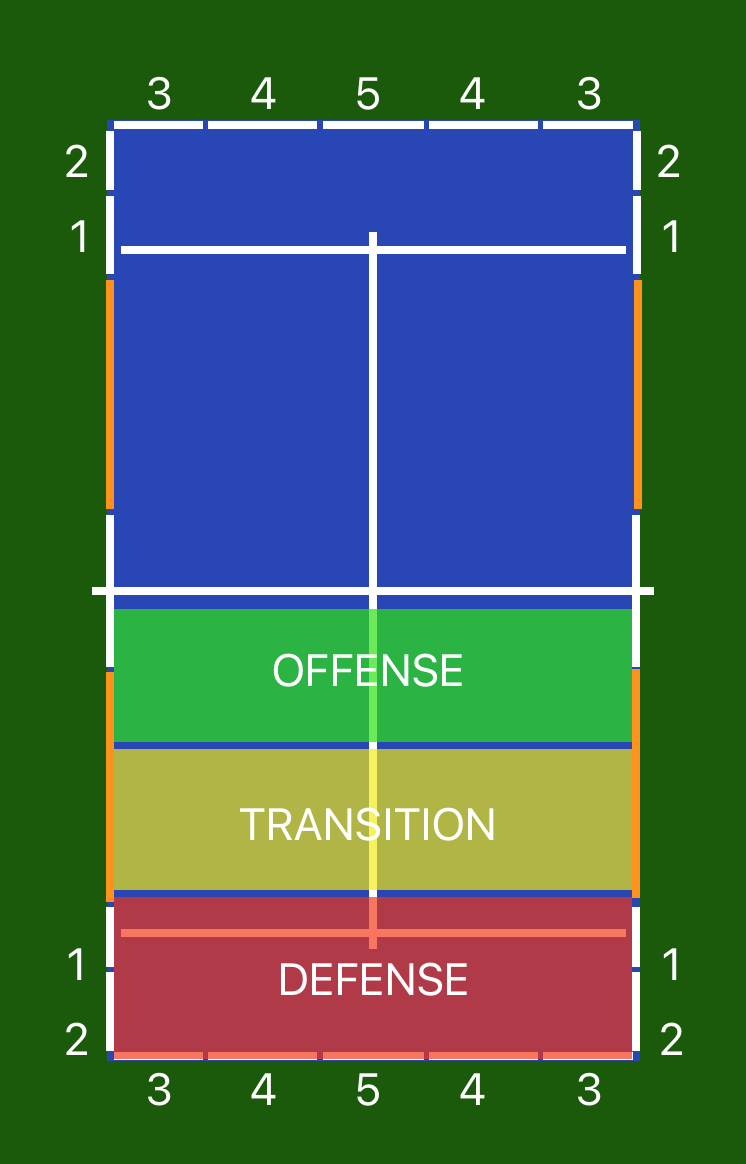
What are the three court zones in padel?
I divide the court into the Defensive Zone near the back glass, the Transition Zone through mid-court and the Golden Zone at the net. Each zone changes the player’s priorities, available shots and acceptable level of risk.
In the Defensive Zone, the first job is to create time and space. In the Transition Zone, the pair must move with purpose rather than stop. In the Golden Zone, the objective is to apply pressure while protecting the space behind the team.
- Defensive Zone: defend, neutralize, use the glass and create a ball that allows the pair to advance.
- Transition Zone: connect defense to attack; move through it quickly and avoid becoming trapped at the feet.
- Golden Zone: control the net, take time away and look for a high-percentage finishing opportunity.
The Net Rule: gain it, keep it or take it away
Before selecting a shot, the player should ask one question: does this ball help us gain the net, keep the net or force the opponents backward? That question connects positioning and shot selection.
A lob from the back is valuable because it can move the opponents away from the Golden Zone. A controlled bandeja is valuable because it can preserve net position. A low volley is valuable because it can prevent the opponents from moving forward.
The Net Rule does not mean attacking every ball. It means recognizing that net control is the strategic objective and choosing the safest path toward it.
Where should players stand at the net?
The Golden Zone is not a painted line. It changes with the quality of the ball, the opponent’s position and the likely reply. Players should be close enough to apply pressure but far enough from the net to protect the lob and react to a fast ball.
The pair must also maintain useful spacing. If one player moves forward, backward or laterally, the partner adjusts. Two individuals standing in good positions can still leave a bad gap if they do not move as one unit.
Common zone mistakes
The most common mistake is living in the Transition Zone. Players advance without a ball that supports the move, stop in mid-court and receive the next ball at their feet.
Another mistake is confusing movement with progress. Running forward after a weak shot does not create an attacking position. The ball must earn the movement.
- Advancing alone while the partner stays behind.
- Standing too close to the net and becoming vulnerable to the lob.
- Retreating after every overhead instead of recovering the Golden Zone.
- Remaining deep after a successful lob instead of taking the space created.
A practical zone drill for tomorrow
Mark the three zones with flat lines. Begin every point in defense. The pair earns one point for gaining the net together and a second point for winning the rally while controlling the Golden Zone.
After each rally, ask the players to identify the ball that allowed them to advance. Track successful net gains out of ten attempts. The objective is not merely to run forward; it is to recognize the correct tactical invitation.
The coaching takeaway
Court awareness gives every other tactical skill a home. When players know where they are, where their partner is and which zone they want to control, better decisions become much easier.
Coaching cue: “Gain the net together, keep it with discipline and make the opponents earn it back.”
Part 10 of Julian Wortelboer’s Tactical Pillar series, developed from the Padel Smash Academy Three Pillars coaching methodology.
Explore Padel Coach Certification
Take your coaching skills to the next level
Master the Art of Coaching Padel
A global methodology for developing players, empowering coaches and growing the sport.
Purchase the book